'/%3E%3C/svg%3E)
'/%3E%3Cpath%20fill='%23b2b2b2'%20d='M241%20382q0%2016%2017%2026%2017%2011%2042%2011t42-11q16-11%2017-26V269H241'/%3E%3Cpath%20fill='%239f7e00'%20d='M241%20379q0%2014%208%2023%209%209%2021%209%2014%200%2021-9%209-9%209-23V269h-59'/%3E%3Cpath%20d='M241%20339v-70h59v110q0%2014-9%2023l-6%205v-68h-15v72q-8%200-14-4v-68zm59%2040c0%2022%2015%2032%2029%2032%2021%200%2030-18%2030-32v-40h-59'/%3E%3Cpath%20fill='%239f7e00'%20d='M266%20277v5h2v12h-3v-5h2v-5h-9v5h2v5h-4v9h3v18h-5v10h34v-10h-5v-18h3v-9h-4v-5h2v-5h-9v5h2v5h-3v-12h2v-5zm42%20101q0%2010%206%2017%206%206%2015%207%2010-1%2016-7%206-7%206-17v-29h-43'/%3E%3Ccircle%20fill='%230044ad'%20cx='329.5'%20cy='372'%20r='6'/%3E%3Cellipse%20fill='%230044ad'%20cx='300'%20cy='340'%20rx='16'%20ry='21'/%3E%3C/svg%3E)


'/%3E%3C/g%3E%3Cuse%20href='%23c'%20transform='matrix(-1%200%200%201%20720%200)'/%3E%3C/svg%3E)









Mindfulness or full awareness, is a practice that invites us to pay attention to the present moment, without judgment or demands. Its goal is to help us get out of “autopilot” and respond to life with more calm, clarity, and kindness toward ourselves.
Beyond the emotional level, this approach has real effects on physical health. Chronic stress—very common during and after cancer—is considered a risk factor for the heart, as it raises blood pressure, alters heart rate, and promotes inflammatory processes.
Several studies have shown that mindfulness and other relaxation techniques can counteract these effects. Regular meditation practice, for example, has been associated with a lower incidence of serious cardiovascular events, such as heart attacks or strokes, especially in people with coronary artery disease.
How does mindfulness contribute to the oncology context?
Facing a cancer diagnosis and its treatment isn’t just a physical challenge: it also has a strong emotional impact. Anxiety, insomnia, fear, and mental fatigue are common reactions at different stages of the process, and if prolonged, they can affect overall well-being and the body’s balance.
In this context, mindfulness presents itself as an effective complementary tool. Cultivating greater awareness of the present moment and an attitude of acceptance helps reduce stress, calm the mind, and improve emotional regulation. These effects not only contribute to psychological well-being but can also promote heart health, something especially important in patients treated with anthracyclines—drugs that are highly effective against cancer, but with potential adverse effects on the cardiovascular system. Taking care of the mind, in these cases, is also a way to protect the heart.
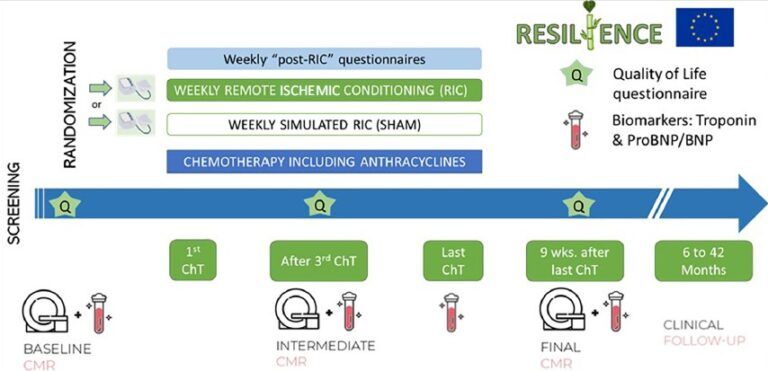
In RESILIENCE clinical trial, we also seek to reduce cardiac damage in cancer patients. In our case, through Remote Ischemic Conditioning (RIC). RIC is a non invasive intervention that involves brief, repeated episodes of interrupted circulation in a limb (arm), thereby promoting the transmission of signals to other organs, such as the heart, making it more resistant to potential damage. In this case, it is more resistant specifically to anthracycline-induced cardiac damage.
Caring for the heart also means caring for the mind
The relationship between emotional and cardiovascular health is increasingly supported by evidence. It’s not just about controlling physical risk factors, but also learning to manage how we respond to stress, change, or uncertainty.
Therefore, in addition to exploring new medical techniques that help minimize the side effects of certain cancer treatments, it is essential to recognize the value of practices such as mindfulness. Both dimensions—physical and emotional—complement each other in a comprehensive approach to care, especially for cancer survivors.
Mindfulness is not an immediate solution, but it is an accessible and transformative tool. It is based on pillars such as:
- Full attention, focused on the here and now.
- Acceptance, which allows us to feel without rejecting or forcing.
- Intention, as a personal driving force for self-care.
- Openness, to observe with curiosity, without judgment.
- And letting go, releasing thoughts that generate suffering.
Mindfulness exercises
There are several simple and accessible ways to incorporate mindfulness into your daily routine. Below are three basic mindfulness exercises that can be practiced without prior experience:
- Body scan: Lie on your back in a comfortable position, with your legs stretched out and your arms relaxed at your sides, palms facing up. Slowly and deliberately direct your attention to each part of your body, starting with your feet and moving up to your head (or vice versa). Notice any associated physical sensations, emotions, or thoughts, without judging or trying to change them.
- Seated meditation: Sit with your back straight, feet flat on the floor, and hands resting in your lap. Focus on your breathing: feel the air moving in and out through your nose. If thoughts or distractions arise, acknowledge them without getting caught up in them.
- Walking meditation: Find a quiet moment in your day, perhaps after work, to walk. It doesn’t have to be a long distance, just pay full attention to the act of walking: the sensation of your feet touching the ground, your balance, the rhythm of the movement. When you reach the end of the walk, calmly turn around and continue, staying focused on your bodily experience.
These practices have proven their ability to lower blood pressure, improve concentration, strengthen emotional resilience, and relieve stress. They don’t replace medical treatment, but they can support the recovery and prevention process, especially when the heart has become more vulnerable after treatment.
Within the framework of RESILIENCE clinical trial, we are working toward a care model that considers not only physical protection against cardiotoxicity, but also the emotional well-being of the patient. We are committed to interventions that combine science, simplicity, and humanity.
Because caring for the body also means caring for the mind. And vice versa.