













Thanks to major advances in oncology, more and more people are surviving cancer. This is undoubtedly great news—but it also raises an important question: how can we protect the long-term health of patients who receive highly effective but sometimes demanding cancer treatments?
One of these treatments is anthracycline-based chemotherapy, widely used for breast cancer and lymphomas. Anthracyclines are essential in oncology and have significantly improved survival rates. However, they can sometimes affect the heart muscle, leading to what is known as cardiotoxicity.
This type of heart damage may appear during treatment—or even years later. That’s why cardiovascular monitoring has become a key part of cancer care. And here an increasingly relevant question emerges: Does cardiotoxicity affect women and men equally?
Why Sex-Specific Differences Matter
For decades, medical research rarely examined outcomes separately in women and men. Women were often underrepresented in clinical trials, and results were not consistently reported by sex. As a result, findings were frequently assumed to apply to everyone.
Today, we know that this assumption is not always accurate.
Women and men differ in biology, physiology, hormone regulation, immune responses, and metabolism. These factors can influence how the body responds to chemotherapy and to cardiovascular stress.
The female heart also has distinct structural and functional characteristics. And, importantly:
- Cardiovascular disease in women often presents with less “classic” symptoms, leading to delays in diagnosis.
- Some studies suggest women may have a different susceptibility to anthracycline-induced cardiotoxicity, although evidence is still evolving.
Understanding these differences is essential to improving prevention and care.
The Research Gap: Why It Matters
The historical underrepresentation of women in cardiovascular research has had real consequences. When data are not analyzed by sex, critical differences can be overlooked—differences that could otherwise inform safer, more precise, and more effective treatment decisions.
Incorporating a gender perspective into research is not ideological—it’s a matter of scientific accuracy.
It allows us to ask more precise questions, such as:
- Is the risk the same for women and men?
- Does cardiotoxicity progress differently?
- Should follow-up care be tailored based on sex?
In cardio-oncology, this is especially important. Many patients receiving anthracyclines are women, particularly women with breast cancer. Understanding how these treatments affect their hearts can lead to better prevention and more personalized care.
What the RESILIENCE Clinical Trial Is Studying
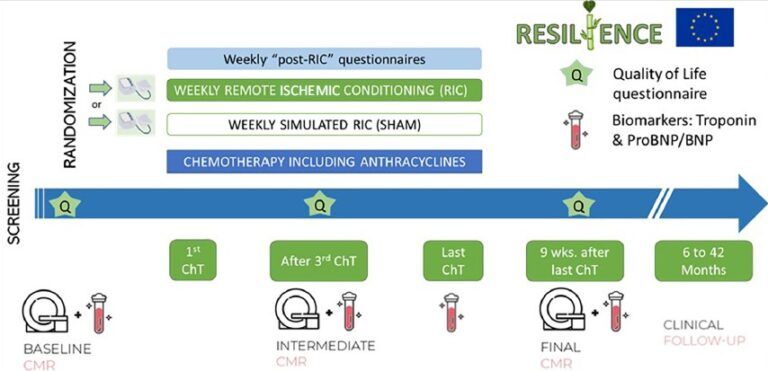
The RESILIENCE trial was designed to answer these questions. Its main goal is to reduce the incidence of anthracycline-induced heart failure using an innovative, non-invasive method called remote ischemic conditioning.
But the project goes further.
One of its key objectives is to determine whether cardiotoxicity differs between women and men. To achieve this, the study uses:
- Cardiac MRI, the gold standard for monitoring heart function
- Specific biomarkers that detect early signs of cardiac injury
This approach makes it possible to evaluate not only the intervention’s effectiveness but also how each sex responds to treatment over time.
What This Means for Women’s Health
Discussing anthracyclines and women is not about generating alarm—it’s about advancing knowledge.
Adding a gender perspective into research makes it possible to move toward more precise and personalized care.
Beating cancer is a major milestone. But preserving cardiovascular health is also part of survivorship, especially considering that cardiovascular disease remains the leading cause of death in Europe.
At RESILIENCE, this is our mission: to help patients live longer and with healthier hearts.