'/%3E%3C/svg%3E)
'/%3E%3Cpath%20fill='%23b2b2b2'%20d='M241%20382q0%2016%2017%2026%2017%2011%2042%2011t42-11q16-11%2017-26V269H241'/%3E%3Cpath%20fill='%239f7e00'%20d='M241%20379q0%2014%208%2023%209%209%2021%209%2014%200%2021-9%209-9%209-23V269h-59'/%3E%3Cpath%20d='M241%20339v-70h59v110q0%2014-9%2023l-6%205v-68h-15v72q-8%200-14-4v-68zm59%2040c0%2022%2015%2032%2029%2032%2021%200%2030-18%2030-32v-40h-59'/%3E%3Cpath%20fill='%239f7e00'%20d='M266%20277v5h2v12h-3v-5h2v-5h-9v5h2v5h-4v9h3v18h-5v10h34v-10h-5v-18h3v-9h-4v-5h2v-5h-9v5h2v5h-3v-12h2v-5zm42%20101q0%2010%206%2017%206%206%2015%207%2010-1%2016-7%206-7%206-17v-29h-43'/%3E%3Ccircle%20fill='%230044ad'%20cx='329.5'%20cy='372'%20r='6'/%3E%3Cellipse%20fill='%230044ad'%20cx='300'%20cy='340'%20rx='16'%20ry='21'/%3E%3C/svg%3E)


'/%3E%3C/g%3E%3Cuse%20href='%23c'%20transform='matrix(-1%200%200%201%20720%200)'/%3E%3C/svg%3E)













Clinical trials are essential for advancing medicine. Thanks to them, today we now have safer, more effective, and increasingly personalized treatments. However, for many people, participating in a clinical trial naturally raises questions: What does participation involve? How does the process unfold? What kind of follow‑up is provided?
At RESILIENCE, we believe that understanding how a clinical trial works from the inside helps build trust, transparency, and peace of mind. Below, we guide you through the process step by step and explain the role of participants at each stage.
What Is a Clinical Trial?
A clinical trial is a research study that evaluates new strategies for prevention, diagnosis, or treatment in people. These studies follow strict scientific protocols and comply with international ethical standards.
The primary goal is to improve medical care and generate knowledge that benefits both current and future patients, while always ensuring the safety and rights of participants.
Clinical Trial Phases
Clinical trials progress gradually through several phases, each with specific objectives. This step-by-step approach ensures that advances are based on solid scientific evidence.
Phase I: Safety and Tolerance
This is the first time a new treatment is tested in people. The primary objective is to assess safety and determine how well the drug or intervention is tolerated.
Researchers assess:
- Treatment tolerance
- Possible side effects
- Best method of administration
- Safe dosage ranges
- How the treatment behaves in the human body
Phase I typically includes 20 to 80 participants, with very intensive monitoring. The information collected helps determine whether the treatment can move on to the next phase.
Phase II: Initial Efficacy
Once initial safety has been established, Phase II evaluates whether the treatment works as expected in people with the condition being studied.
During this phase:
- Efficacy is measured for the first time
- Dosages and treatment schedules are refined
- More detailed information about potential benefits is collected
Usually, 100 to 300 participants take part, and studies last longer than those in Phase I.
Phase III: Comparison and Confirmation
Phase III is one of the most critical stages of a clinical trial. In this phase, researchers confirm the treatment’s safety and efficacy by comparing it, when ethically appropriate, with standard treatment or placebo.
Key features include:
- Large participant numbers (300 to several thousand)
- Multicenter, often multinational studies
- Comprehensive assessment of benefits, risks, and side effects
If the results are positive, regulatory authorities such as the European Medicines Agency (EMA) may authorize the treatment for clinical use.
Phase IV: Long-Term Follow-Up
Once approved and available on the market, the treatment continues to be evaluated in real‑world clinical practice.
Phase IV helps:
- Analyze long-term effects
- Detect rare adverse events
- Confirm effectiveness in broader populations
- Identify additional benefits in specific patient profiles
There is no fixed duration, continuous monitoring is essential for optimizing long-term use.
A Rigorous, Necessary Journey
From the initial Phase I studies to final approval, developing a new treatment typically takes 10 to 15 years. This timeframe depends on many factors, including the disease being investigated, the type of treatment, study duration, and the number of participants.
Rather than being an obstacle, this thorough process ensures that every medical advancement is supported by strong evidence and places participant safety first.
What Is Follow‑Up Like During a Clinical Trial?
Follow‑up is a key part of any clinical trial. Participants receive continuous,personalized monitoring, which may include:
- Regular medical visits
- Diagnostic and imaging tests
- Laboratory tests and biomarker evaluations
- Detailed recording of side effects and clinical progress
- Ongoing communication with the research team
All procedures are carefully defined in study protocols and overseen by ethics committees and independent health authorities.
Participant Safety and Rights
Participation is always voluntary. Before joining a trial, individuals receive clear, detailed information and sign an informed consent document.
Participants always have the right to:
- Leave the study at any time
- Receive guaranteed medical care
- Have their data kept confidential
- Be protected, safety is the top priority
Making an Informed Decision
Participating in a clinical trial not only provides access to specialized follow‑up but also contributes to scientific progress and better care for future patients.
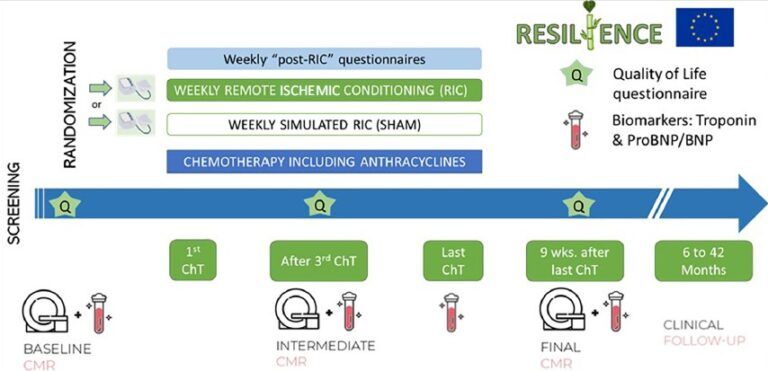
RESILIENCE is a multicenter, prospective, randomized, double‑blind, placebo‑controlled Phase II clinical trial evaluating the efficacy and safety of weekly remote ischemic conditioning in patients with lymphoma and breast cancer receiving anthracyclines.
At RESILIENCE, we believe research should be transparent, accessible, and centered on people. Understanding how a clinical trial works is the first step toward making well‑informed, confident decisions.