'/%3E%3C/svg%3E)
'/%3E%3Cpath%20fill='%23b2b2b2'%20d='M241%20382q0%2016%2017%2026%2017%2011%2042%2011t42-11q16-11%2017-26V269H241'/%3E%3Cpath%20fill='%239f7e00'%20d='M241%20379q0%2014%208%2023%209%209%2021%209%2014%200%2021-9%209-9%209-23V269h-59'/%3E%3Cpath%20d='M241%20339v-70h59v110q0%2014-9%2023l-6%205v-68h-15v72q-8%200-14-4v-68zm59%2040c0%2022%2015%2032%2029%2032%2021%200%2030-18%2030-32v-40h-59'/%3E%3Cpath%20fill='%239f7e00'%20d='M266%20277v5h2v12h-3v-5h2v-5h-9v5h2v5h-4v9h3v18h-5v10h34v-10h-5v-18h3v-9h-4v-5h2v-5h-9v5h2v5h-3v-12h2v-5zm42%20101q0%2010%206%2017%206%206%2015%207%2010-1%2016-7%206-7%206-17v-29h-43'/%3E%3Ccircle%20fill='%230044ad'%20cx='329.5'%20cy='372'%20r='6'/%3E%3Cellipse%20fill='%230044ad'%20cx='300'%20cy='340'%20rx='16'%20ry='21'/%3E%3C/svg%3E)


'/%3E%3C/g%3E%3Cuse%20href='%23c'%20transform='matrix(-1%200%200%201%20720%200)'/%3E%3C/svg%3E)














What is a clinical trial?
Clinical trials are medical studies that allow us to find new, safe and effective ways to treat or prevent diseases. Before reaching this phase, treatments have been rigorously evaluated in the laboratory to ensure their viability. Only the most promising options advance to clinical trials.
Each trial follows a specific protocol that defines where and how the treatment will be carried out, as well as the guidelines established by the medical team. In addition, participants can play an active role in the study, monitoring their health or completing forms about their progress and well-being.
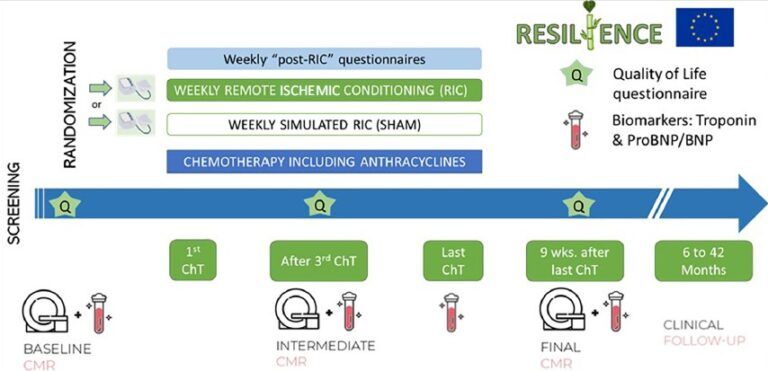
The RESILIENCE project, funded by the European Commission, is an example of an innovative clinical trial that seeks to protect the cardiovascular health of cancer patients. Through Remote Ischemic Conditioning (RIC), RESILIENCE investigates a strategy to prevent heart failure in patients treated with anthracyclines, thus contributing to a better quality of life.
Types of clinical trials
To ensure impartiality in the allocation of treatments within a clinical trial and to prevent the expectations of participants or researchers from influencing the results, the selection is done randomly.
There are different types of trials depending on the level of information handled by those involved:
- Blind or masked trials: the participant does not know which treatment he or she is receiving, but the research team does.
- Double-blind trials: neither the participants nor the research team know which treatment is being administered; this information is only handled by the pharmacist.
- Triple-blind trials: both the administration of the treatment and the analysis and evaluation of the data are carried out without knowing the identity of the groups.
If during the course of the study it is shown that a treatment is effective, the trial can be stopped so that all participants receive the most beneficial option.
It is important to mention that there are also open clinical trials, in which both the researcher and the patient know the treatment being assigned.
In the case of RESILIENCE, it is a double-blind clinical trial evaluating the efficacy and safety of weekly remote ischemic conditioning in patients with lymphoma receiving anthracyclines.
What are the requirements for a clinical trial?
The requirements for participating in a clinical trial can vary greatly, as each research study has specific purposes and protocols.
Based on their study, researchers define inclusion and exclusion criteria based on age, biological sex, and/or disease (or absence thereof), among other factors.
To participate in a clinical trial, candidates must meet certain criteria established in the study. The person may be required to have a specific disease, to have received a certain treatment, or to have certain biomarkers.
Similarly, there may also be exclusion criteria, such as not having shown recent symptoms of the disease, having recently undergone surgery, or suffering from conditions that pose a risk to the treatment.
In RESILIENCE, the clinical trial is aimed at patients undergoing treatment with anthracyclines, a type of chemotherapy that can affect heart function. Those who meet the medical criteria may be eligible to participate in the study to receive this innovative cardiovascular prevention strategy.
How to enroll in a clinical trial?
Whether by medical recommendation or by a personal search for clinical trials related to a specific pathology, before participating in a study it is necessary to go through a process called informed consent.
The purpose of this process is to ensure that participants fully understand the development of the clinical trial. The research team will review this document, which explains the objective of the study, its methodology and possible risks and benefits; which will allow an informed decision.
In the case of RESILIENCE, the participating hospitals explain all the details of the study to patients before they decide to take part in the trial. Transparency and safety are fundamental pillars in our work and in any medical research.
What should an informed consent include?
Informed consent includes detailed information about the treatment and the study, among other key aspects:
Treatment:
- Definition of the treatment.
- Purpose of the clinical trial (the information that doctors hope to collect).
- Inclusion and exclusion requirements for the clinical trial.
- Up-to-date information about the treatment under investigation.
- Possible risks and benefits.
Tests:
- Types of tests that will be performed during the trial.
- Frequency, duration, and location of the tests.
Costs:
- Who will bear the costs of the trial.
- If the clinical trial requires additional tests, who will bear the cost.
In addition, informed consent must be kept up to date, so if any risks or benefits are discovered throughout the treatment, participants must be informed.
At RESILIENCE, this process is critical to ensuring patients fully understand their participation in the study and make decisions based on clear and transparent information.