'/%3E%3C/svg%3E)
'/%3E%3Cpath%20fill='%23b2b2b2'%20d='M241%20382q0%2016%2017%2026%2017%2011%2042%2011t42-11q16-11%2017-26V269H241'/%3E%3Cpath%20fill='%239f7e00'%20d='M241%20379q0%2014%208%2023%209%209%2021%209%2014%200%2021-9%209-9%209-23V269h-59'/%3E%3Cpath%20d='M241%20339v-70h59v110q0%2014-9%2023l-6%205v-68h-15v72q-8%200-14-4v-68zm59%2040c0%2022%2015%2032%2029%2032%2021%200%2030-18%2030-32v-40h-59'/%3E%3Cpath%20fill='%239f7e00'%20d='M266%20277v5h2v12h-3v-5h2v-5h-9v5h2v5h-4v9h3v18h-5v10h34v-10h-5v-18h3v-9h-4v-5h2v-5h-9v5h2v5h-3v-12h2v-5zm42%20101q0%2010%206%2017%206%206%2015%207%2010-1%2016-7%206-7%206-17v-29h-43'/%3E%3Ccircle%20fill='%230044ad'%20cx='329.5'%20cy='372'%20r='6'/%3E%3Cellipse%20fill='%230044ad'%20cx='300'%20cy='340'%20rx='16'%20ry='21'/%3E%3C/svg%3E)


'/%3E%3C/g%3E%3Cuse%20href='%23c'%20transform='matrix(-1%200%200%201%20720%200)'/%3E%3C/svg%3E)














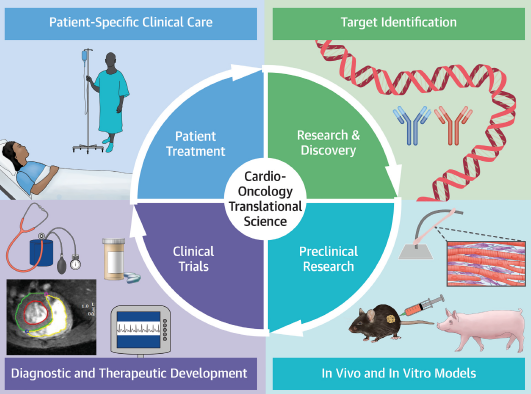
When a new medical intervention begins to be tested in people, research progresses through different phases of clinical trials. Each phase is designed to answer specific questions and provide more information about the intervention’s safety, potential effectiveness, and how it should be investigated further.
Phase II plays a particularly important role in this process because it is the stage at which researchers begin to evaluate in greater detail whether an intervention produces the desired effect in a specific patient population, while continuing to closely monitor its safety.
What Is Studied in a Phase II Trial?
The primary objective of a Phase II trial is to obtain initial evidence of whether an intervention may be effective.
At this stage, researchers investigate whether a new treatment or intervention produces the intended effect, while continuing to collect information about its safety and how it affects the body.
Researchers assess questions such as:
- Does the treatment or intervention produce the expected effect?
- What changes are observed in patients?
- What adverse effects may occur?
- Do the results justify further investigation in later trial phases?
Unlike the earliest stages of clinical research, Phase II is not focused solely on safety. It also begins to address a fundamental question: does the intervention achieve the effect it is intended to produce?
How Many People Participate?
Phase II trials typically involve more participants than early-stage studies, although the exact number depends on the disease being studied, the intervention, and the trial design.
There is no single sample size that applies to all studies. In fact, the number of participants is determined according to the objectives and specific design of each research project.
What matters is that enough participants are included to generate meaningful data on the intervention’s potential effectiveness while continuing to evaluate its safety.
How Are Results Compared?
Many clinical trials use comparison groups to help interpret results accurately.
For example, some participants may receive the intervention being investigated, while others receive standard treatment, a placebo, or a sham intervention.
Trials may also use:
- Randomized designs, in which participants are assigned to study groups by chance.
- Double-blind designs, in which treatment allocation is concealed from both participants and healthcare professionals involved in the study.
These measures help reduce potential bias and allow results to be compared rigorously. They also help determine whether any observed changes can genuinely be attributed to that intervention.
What Happens After Phase II?
Once a Phase II trial has been completed, researchers analyze the data to understand what the results show.
If the findings indicate sufficient evidence of effectiveness and an acceptable safety profile, the intervention may progress to larger Phase III studies.
In this next stage, the goal is typically to confirm the findings and compare the intervention with alternative treatments in a larger patient population.
If the results do not support the original hypothesis, that information remains valuable, as it can guide future research and help shape new scientific approaches.
What Does This Mean for RESILIENCE?
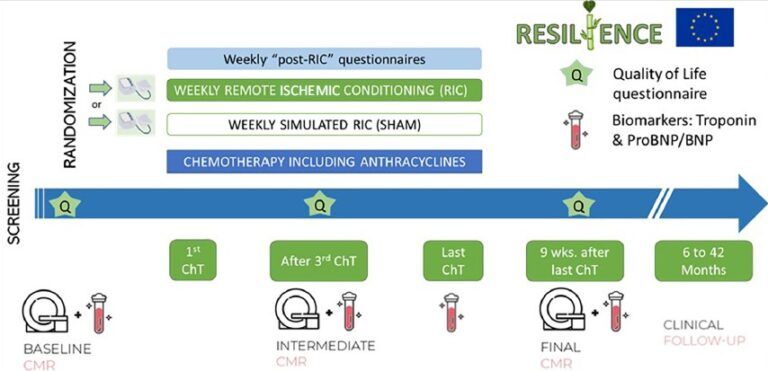
RESILIENCE is a multinational, prospective, randomized, double-blind, sham-controlled Phase II clinical trial.
The project studies the safety and effectiveness of Remote Ischemic Conditioning (RIC) in patients with lymphoma and other types of cancer who are receiving anthracycline-based chemotherapy and are at risk of cardiotoxicity.
Participants are randomly assigned to either the RIC group or a sham procedure group and undergo three cardiac magnetic resonance imaging (MRI) assessments throughout the trial.
The aim is to generate evidence that will help determine whether this technique can reduce anthracycline-associated cardiotoxicity and whether there is sufficient justification for further clinical investigation.
A Key Stage in Advancing Research
Phase II represents a critical milestone in clinical research.
It is the stage at which an intervention begins to generate evidence of potential effectiveness in patients while its safety continues to be evaluated.
In projects such as RESILIENCE, Phase II trials transform a scientific hypothesis into clinical data that can help answer a very specific question:
Can Remote Ischemic Conditioning become a highly effective strategy for helping protect the hearts of patients receiving anthracycline treatment?
Every phase contributes knowledge. Every data point helps move research forward.
RESILIENCE helps you survive cancer with a stronger heart.